
On a glass processing line, ceramic ink drying isn’t a nice-to-have—it’s the last handle you’ve got before the glass leaves the line. When the infrared module doesn’t pull its weight, you see uneven color, adhesion that falls off, or cycle times that drag down tempering and bending. We built our ceramic ink drying infrared systems to live in those lines, not just sit next to them.
What matters, technically
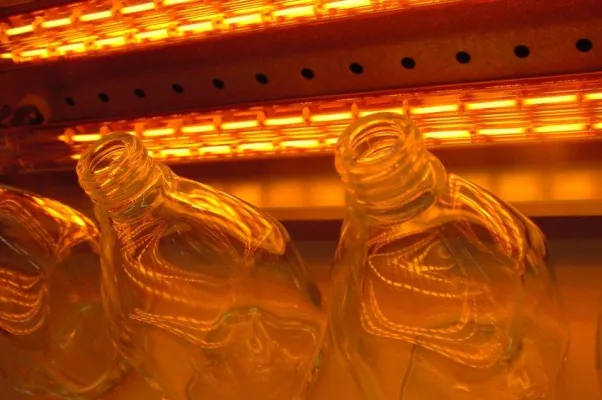
We lean on short-wave infrared emitters with fast response and high power density, so the heat hits the ink layer first instead of warming up the furnace air. That gets solvents out fast without scorching the glass surface. Control stays repeatable: closed-loop temperature feedback, adjustable power density, and a thermal field that spreads evenly. That cuts hot spots that can drive thermal stress in tempered or bent parts. The specs line up with industrial glass equipment—standard voltage options, a compact mounting footprint, and quartz components built for nonstop duty in coating and drying zones.
Why it holds up in real production
In the flow, short-wave infrared shortens dwell time and bumps line speed without giving up quality. You get sharper print definition, stronger ink adhesion, and fewer rejects from curing that didn’t finish. Energy use drops because the heat is targeted, and recovery between cycles is quicker than what you get with broad convection heating. The module also keeps output consistent across multiple glass thicknesses. That matters when you’re switching between architectural, automotive, and specialty glass without scrapping the whole thermal profile.
What you need to keep straight
Installation is straightforward, but alignment is the make-or-break. Emitter position has to match the print width and hold the designed standoff distance—otherwise you’re chasing uneven drying and localized overheating. We supply adapter kits and wiring options for common glass machinery brands, so you can swap in with minimal downtime. Plan for proper cooling and clean airflow. Dust and solvent vapor will shorten emitter life and push temperature control off. Match the module to the line, and it will hold the process window you need, shift after shift.