

Getting the Heat Right: The Truth About Annealing Lab Glass
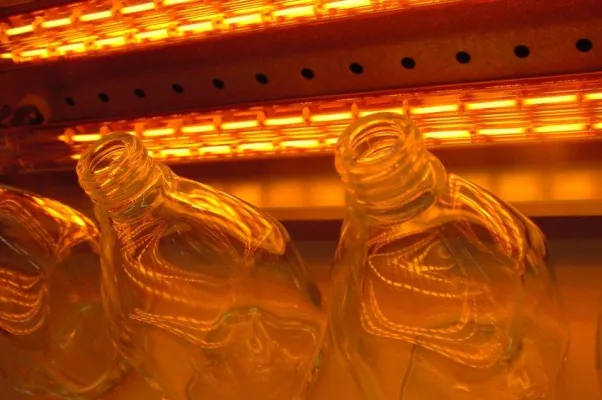
When you’re working with lab-grade glassware, there’s almost zero room for mistakes. One bad temperature swing and you’ve baked internal stress right into the glass. The worst part? It doesn’t always break in the shop. It might wait until it’s in a lab, under a vacuum or mid-reaction, and then just… shatter. That’s a nightmare nobody wants. To stop that from happening, we rely on fast-response infrared (IR) elements that can hold a temperature within 0.1°C.
Why that tiny 0.1°C actually matters
Glass is stubborn. It doesn’t heat or cool evenly. To get it right, you have to hold the glass exactly at its annealing point so the molecules can settle into place without the whole piece warping. If you’re off by even a couple of degrees, you get a thermal gradient across the walls. We use short-wave IR emitters because they don’t just sit on the surface—they penetrate the glass and heat the bulk of the material way faster than those old-school resistive coils. That 0.1°C precision isn’t just a bragging right on a spec sheet. It’s what keeps the vessel from exploding when things get intense in the lab.
Cutting out the lag
Here’s the problem with standard heaters: they have too much thermal mass. They’re slow. By the time a clunky heater realizes the temperature has dropped, your glass has already drifted past the critical zone. Our IR elements fix that. They react almost instantly to the PID controller. It creates a really tight loop. The emitter switches output in milliseconds, which basically locks the glass surface to your setpoint. It’s snappy. It’s predictable.
The catch: Power density
Now, there is a trade-off. High-precision IR heating packs a lot of energy into a small space. Because of that, you have to be smart about your zoning. If your lamps are too close or aren’t balanced around the vessel, you’ll end up with “hot spots.” You’ve got to get the shielding and spacing just right. If you don’t, you’ll end up introducing the exact same stress you were trying to get rid of in the first place.